Monopoly Live Casino UK: How the Live Format Works
 Available in GB
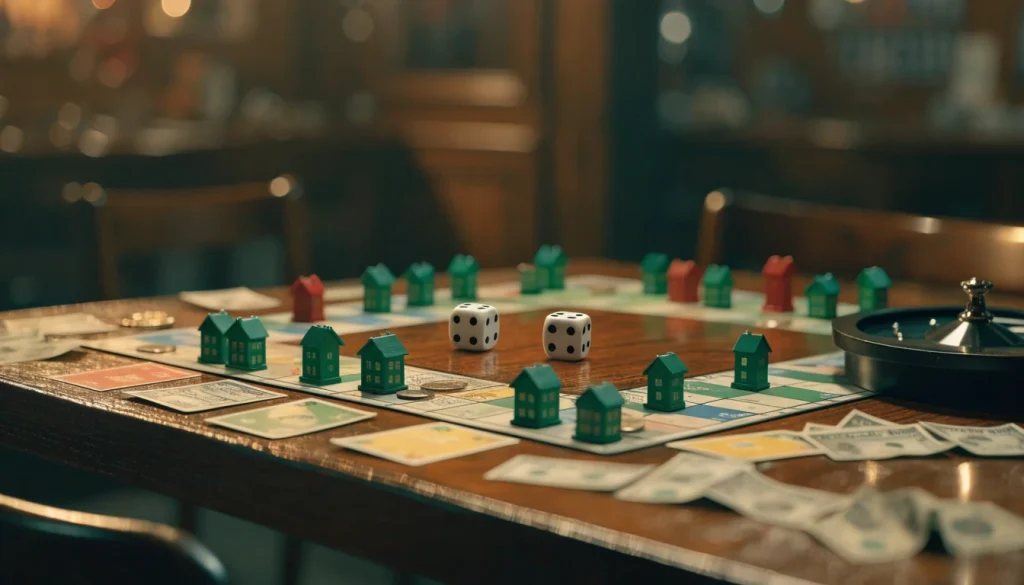
See how a studio stream and on-screen betting shape the experience, and why the Monopoly theme alone does not explain how a round works.
Table of Contents
- A Familiar Board, Recast as a Live Casino Format
- Online Play, with the Pace of a Real Table
- What Makes a Casino Site Suitable for Live Play
- The Rules at the Table, and the Limits of a Betting System
- The Dealer Is Part of the Game
- Strategy, Statistics and the Temptation to Find a Pattern
- Choosing a Live Casino Site Without a Shopping List
- Roulette Stats, Wheel Layouts and the Odds Behind Them
- Demo Play: Practice, Not Payout
- Free Play, Welcome Offers and the Small Print
- Casino Games
A Familiar Board, Recast as a Live Casino Format
The Monopoly board belongs to a domestic kind of theatre: a small world laid out on a table, where streets have prices, fortunes change hands and ownership is reduced to coloured squares and paper money. Its familiarity makes the name easy to recognise when it appears in a casino setting. But a familiar name is not a full explanation of a game. “Monopoly Live” can describe a casino product built around that theme; it does not, by itself, establish the rules, the equipment on screen or how any particular round works.
The important distinction is between the theme and the format. A conventional digital casino game is generated and displayed by software. A live-dealer game, by contrast, shows gameplay as it happens in a studio, with a human dealer present in the stream. Bets are placed through an on-screen interface. The screen is therefore doing two jobs: carrying a real-time view of the studio and providing the controls for participation.
Choosing a Monopoly Live casino involves more than finding the game; payout timing is one practical detail to check. This list gives a brief reference point for the operators featured on this page.
1. Chanze
Payout speed: 1-3 business days Chanze lists a payout speed of 1–3 business days, a useful detail to consider when reviewing its Monopoly Live offering.
2. Zombillion
Payout speed: 1-3 business days Zombillion lists a payout speed of 1–3 business days. This provides a clear timing reference when considering the operator.
3. WinBeast
Payout speed: 1-3 business days WinBeast lists payouts as taking 1–3 business days, giving readers a stated timeframe to bear in mind.
4. Revery Play
Payout speed: 1-3 business days Revery Play lists a payout speed of 1–3 business days, which is the available practical detail for this reference.
5. Amunbet
Payout speed: 1-3 business days Amunbet lists a payout speed of 1–3 business days. Readers can use that stated timeframe when assessing the operator.
6. EvoSpin
Payout speed: 1-3 business days EvoSpin lists payouts as taking 1–3 business days, offering a stated timeframe to consider.
7. Dieselwin
Payout speed: 1-3 business days Dieselwin lists a payout speed of 1–3 business days, the available detail to note when reviewing its offering.
8. Britsino
Payout speed: 1-3 business days Britsino lists payouts as taking 1–3 business days, providing a straightforward reference for payout timing.
9. Jetsetspins
Payout speed: 1-3 business days Jetsetspins lists a payout speed of 1–3 business days. This is the known detail to consider when reviewing the operator.
10. NightWin
Payout speed: 1-3 business days NightWin lists payouts as taking 1–3 business days, giving readers a stated timeframe to keep in mind.
That blend can make a casino game feel less like an isolated piece of software and more like a shared event. The dealer, the room and the unfolding action give the stream a physical setting, while the interface keeps the player at a distance from the table itself. It is a modern arrangement with an old social shape: people gather around an event, but the gathering is mediated by a screen.
The Monopoly connection adds another layer. The board game’s symbols carry a history of buying, trading and accumulating property, even for people who have never studied its rules closely. In a casino context, those associations are recognisable decoration, not proof that the casino game reproduces the board game or follows its mechanics. The resemblance may be visual or thematic; the format must be understood on its own terms.
This matters because the phrase “live” can encourage assumptions. It may suggest that every part of the experience behaves like a familiar board game, or that the title alone reveals what a player will see. Neither follows. The live element refers to the streamed, real-time studio format. Details of a named game—its rules, available choices and outcome structure—need to be established from that game’s own information, rather than inferred from a well-known logo.
Online Bingo UK: Cards, Patterns and Prize Lines
In Britain, live-dealer casino games are legal when offered by an operator holding a UK Gambling Commission licence. That regulatory framework is part of the setting, not an ornamental footnote. A casino product can borrow the language and imagery of popular culture, but real-money play still belongs to a regulated market. The Gambling Act 2005 governs gambling in England, Wales and Scotland, while Northern Ireland has a separate legal framework; the general point for the British market is that remote operators serving customers must hold the relevant Commission licence.
The broader appeal of the format is easy to understand without turning it into a promise. A streamed studio makes the process visible in a way that a purely digital display does not. A human dealer is present in real time, and the action is transmitted rather than represented solely by animation. That visibility can lend proceedings a sense of occasion. It does not make the outcome more predictable, nor does it transform a casino game into a board-game night with different scenery.
The phrase “Monopoly Live casino” therefore describes a meeting of two familiar forms: a recognisable cultural property and a live casino presentation. The former supplies associations; the latter supplies the streamed studio and betting interface. Keeping those parts separate is useful. It prevents a theme from being mistaken for a rulebook, and a real-time broadcast from being mistaken for a guarantee of transparency about every aspect of play.
There is a small cultural irony in the journey. Monopoly began as a game about property and economic power, its compact board turning ownership into a contest that could be played at home. In a casino, the same recognisable world is recast as entertainment for an individual at a screen. The symbols travel well. Their meaning changes.
Gambling Risk
This is gambling, not a route to income, and it is for entertainment only, not gambling advice.
For anyone considering real-money play, the responsible frame is deliberately less theatrical: this is gambling, not a route to income, and it is for entertainment only, not gambling advice. A set budget should be decided in advance and kept intact. The themed presentation may feel familiar; the financial stakes are not the same as moving a token around a living-room board. Familiarity is not control.
Online Play, with the Pace of a Real Table
The appeal of a Monopoly-themed live casino game is easy to understand: a familiar name, presented in a setting that has the measured rhythm of a table rather than the quick, solitary turn of a conventional digital game. But playing online does not make that rhythm disappear. The screen is a window onto a slower process, and the time between decisions is part of the experience.
That can feel like a small change until a session begins. Digital games are built to move quickly; live games take longer to unfold. A player waits for the action at the table, then makes a choice through the on-screen interface. The pause is not necessarily a fault in the connection or a sign that the game has stopped. It is a feature of a format whose pace is governed by events taking place in real time.
Penny Slot Machines in the UK: Costs and Odds
The distinction matters for anyone arriving from fast digital play. A rapid sequence of turns can encourage a sense of momentum, while the live table inserts gaps in which there is little to do but wait. Some people will find that more sociable or absorbing; others may find the slower tempo frustrating. Neither response alters the basic fact that the game takes longer to progress. A session should be judged by its actual pace, not by the speed of the screen animations around it.
The connection has a practical role, too. Live play requires stable internet. A game that depends on an ongoing stream is less forgiving of an unreliable connection than a self-contained digital version. Interruptions can make it harder to follow what is happening or to act at the appropriate point. That is not a special complication of Monopoly Live, but a condition of live casino play generally: the experience relies on a connection that can keep up with events as they happen.
This also changes where online play fits into ordinary life. A live table is not as easily treated as a spare-minute diversion when its pace is slower and the stream needs attention. Trying to play while moving between tasks can turn a deliberate format into a badly timed one. The interface may be on a phone or computer, but the game is not thereby obliged to accommodate every distraction in the room. Technology has made the table portable; it has not made attention portable in quite the same way.
Live casino play requires a stable internet connection, as the experience relies on a real-time stream that can be less forgiving of interruptions than digital games.
Cost is another practical difference. Live games have higher minimum bets than digital versions, although the precise starting limit depends on the table. A specialist review has reported that many live roulette and baccarat tables begin at around 20p, while blackjack tables often have higher starting limits. That is a report about tables described by that kind of source, not a permanent price list for every operator or game. Limits can vary, and the figure should not be mistaken for a promise about a particular Monopoly-themed table.
The broader point is less numerical: the smallest available stake can shape the character of a session. A player who is accustomed to low-stake digital play may find that a live table offers fewer comfortable entry points. Higher minimums can make each decision feel more consequential, especially when combined with a slower round of play. The format does not become more predictable because the action takes longer. It simply gives each decision more room to be noticed.
That is one reason a budget belongs before the session, not halfway through it. A set amount provides a boundary for spending; it should not be treated as a target to recover after a loss, or as an invitation to continue after a win. The long pauses of live play can make a decision feel considered, but deliberation alone does not make it safer. A limit that shifts whenever the balance changes is not much of a limit.
Mines Casino Game in the UK: Rules and Risks
Online Monopoly Live, then, is not merely a familiar game transferred to a screen. It asks for a suitable connection, time for a slower sequence of events and acceptance that the table’s minimum may be higher than a digital game’s. Those conditions are mundane, which is precisely why they matter. The spectacle gets the attention. The connection and the stake do the accounting.
What Makes a Casino Site Suitable for Live Play
A casino can look polished and still be unsuitable for live play. The more useful test is whether its legal status, table information and terms are clear before money is involved. This matters as much when comparing sites offering Monopoly Live as when looking at any other live-dealer game: a familiar name does not make every operator serving it equally trustworthy.
In the UK, a live-dealer casino is legal only if the operator holds a licence from the UK Gambling Commission. Remote gambling businesses selling into the British market need the relevant licence even when their business is based elsewhere. The distinction is practical, not decorative. A site’s own claim to be licensed should be checked against the Commission’s public register, with care taken to match the named operator and website rather than relying on a logo in the footer. A licence belongs to an operator, not to a general impression of professionalism.
This is one of the less glamorous features of a casino site, and one of the more important ones. British gambling law places responsibility on operators to work within a local regulatory system; it does not turn a polished interface into evidence of compliance. A site that makes its legal identity difficult to establish has already made the assessment harder than it needs to be.
Verifying Casino Suitability
- Check the operator’s licence against the UK Gambling Commission public register
- Verify the specific table’s minimum and maximum stakes
- Read the rules and paytable before placing a bet
- Review bonus terms for wagering requirements and game weighting
Table limits are another practical measure, but they are not a simple quality score. A minimum stake determines whether a table fits a particular budget; a maximum stake sets the other boundary. Both can differ between tables and can change, so a general statement about what a casino offers is less useful than the limits displayed for the specific table at the time of play. The visible range also helps distinguish a site with meaningful choice from one whose advertised live section contains little that suits a given budget.
A specialist review has reported that some live roulette and baccarat tables begin at around 20p, while blackjack tables often have higher starting limits. That is a reported snapshot, not a dependable market-wide promise. The table itself is the relevant reference point. A low minimum may make a game accessible, but it says nothing by itself about the operator’s licensing, the clarity of its rules or the suitability of its terms.
Before choosing a table, the rules and paytable should be available in a form that can be read before a stake is placed. The name of a game may be familiar, but variations in table conditions and payouts can affect what a session means in practice. For a search centred on Monopoly Live, the same restraint applies: the title alone is not enough to establish the rules or features offered at a particular site. The game information shown by the operator is the point to inspect, rather than assumptions borrowed from another casino.
Keno Casinos in the UK: Games, Odds and Terms
The same care is needed with a “Monopoly Live bonus”. A promotional label does not establish that an offer applies to a live table, or explain the conditions attached to it. Bonus terms can specify which games count and how much they contribute towards wagering requirements. Those details matter more than the headline. Before opting in, the terms should be checked for wagering requirements, game weighting and any maximum bet limits. A promotion that looks generous in a banner can be much less useful when its restrictions are read closely.
Results pages and game histories can also create a false sense of certainty. A displayed result may help explain what has happened, but it cannot establish that a future outcome will follow a pattern. Site suitability is better judged by what can be verified: the operator’s licence, the table’s stated limits, accessible game information and readable terms. Claims that results reveal what comes next are not a substitute for any of these.
The word “best” is tempting because it suggests a single answer. In practice, the relevant choice depends on whether the operator is properly licensed and whether its table conditions and terms are clear and compatible with the intended budget. A ranking can compare operators, but it cannot remove the need to check the specific table and offer. In gambling, paperwork is part of the experience. Not the thrilling part.
The Rules at the Table, and the Limits of a Betting System
Blackjack gives the player a compact objective: finish with a hand closer to 21 than the dealer’s, without going over. The target is easy to remember; the decisions around it are less tidy. Each hand has its own outcome, while the house edge remains part of the game across repeated play. A staking pattern can change the size of a bet, but not that underlying relationship.
Attention A betting system describes how to stake money across hands, but it does not rewrite the game rules or remove the house edge.
This distinction matters in any casino setting where a familiar name or polished presentation can make play feel more predictable than it is. Rules describe what can happen during a hand; a betting system describes how someone chooses to stake money across hands. The second does not rewrite the first.
Martingale is the classic example. After a loss, the player raises the next stake in an attempt to recover what has gone before if a later hand wins. The arithmetic may look persuasive in a short sequence, but it cannot ensure a recovery. Further losses can arrive before a winning hand, and the growing stakes mean that the amount at risk grows too. Blackjack still has a house edge. The system does not remove it.
There is a social history in the appeal. Games built around chance invite people to look for a method that makes uncertainty feel governed. A progression of stakes supplies one: loss becomes a temporary setback, the next bet a planned correction. The plan can be emotionally neat. The outcome need not be.
A betting system also shifts attention away from the hand itself. Blackjack is not simply a question of how much to stake; it is a game with rules that shape the choices available at the table. Those rules can vary between games, so the table rules and paytable deserve attention before play begins. A strategy carried over from one set of conditions may not fit another.
The sensible boundary is financial rather than mathematical. A budget set before play gives a stopping point that is not dependent on the last result. Once it is reached, neither a losing run nor the hope of extending a winning one is a reason to move it. Chasing changes the limit after the fact, precisely when judgement is under pressure.
Online casino without ID in the UK: checks explained
That is the unglamorous part. A winning hand does not prove a system works, just as a loss does not promise a correction in the next one. Each result can feel like evidence when money is involved; feeling is not a reliable ledger.
For anyone looking to play a casino game online, the practical distinction is between learning the rules and expecting a staking formula to control chance. The former can clarify what a hand asks of its players. The latter can only organise the bets placed. It cannot turn an unfavourable edge into a favourable one, or guarantee that losses will be recovered.
Entertainment, not gambling advice.
The Dealer Is Part of the Game
A live blackjack table has a person at its centre. The dealer is not an animation moving cards across a polished screen, but a human being shown in a real-time stream, handling physical cards from a standard deck. That small material fact changes the texture of the game. Cards have edges, hands move, and the action is conducted in a shared space, even when the players are elsewhere.
The camera makes the dealer visible; the table makes the dealer consequential. Players can interact with the dealer, and some live blackjack games provide chat through which messages can be exchanged with the dealer and other players. The contact is necessarily bounded by the game and its interface. Still, it gives the table a social surface that a solitary digital game does not have. There is a person on the other side of the felt, and other people are present in the same round.
That presence belongs to a much older idea of gambling: not simply a wager against a mathematical arrangement, but a public ritual with a host, an audience and a sequence of visible gestures. A dealer turns procedure into performance. The cards are dealt in view, while the camera supplies the stage. The modern casino has not abolished the table; it has made the table portable.
Low-Volatility Slots in the UK: How They Work
For a reader searching for a Monopoly-themed live casino game, the distinction matters. A title or theme alone does not establish what happens on screen, who deals, or whether a particular game includes a human host. Live blackjack offers a clear example of the human-dealer format, but its features should not be transferred to a different game merely because both appear in a live casino. The name is not the table.
Some blackjack tables also offer side bets, which sit alongside the main wager, or a Bet Behind option, which allows a player to wager on another participant’s hand. These are additions to the table’s social arrangement, not evidence that every game provides them. Their availability depends on the particular game. They can make the screen feel busier, but the dealer remains the visible point around which the action is organised.
There is a quiet contrast here between automation and ceremony. A digital game can deliver its result without anyone being seen to handle anything. At a live table, the dealing itself is part of what is watched. That does not make the outcome more personal, or turn a stream into a private relationship with the dealer. It does make the process legible: hands move, cards appear, and the game proceeds in public view.
The human element, then, is not a promise of conversation or a special advantage. It is a feature of the setting: physical cards, a visible dealer and, where available, a channel for brief exchange. A table with company.
Strategy, Statistics and the Temptation to Find a Pattern
A record of earlier outcomes can look like a map. In roulette, a tracker may arrange past results into runs, gaps or repeated numbers, turning chance into something that appears to have a memory. The record is real; the forecast is not. A number appearing often, or not appearing for a while, does not make it more or less likely on the next spin.
Statistics Limit
Historical results can describe what has already happened, but they cannot establish a dependable route to future outcomes.
That distinction matters when people look for a Monopoly Live strategy, or search for the game’s history and statistics. Historical results can describe what has already happened, but they cannot establish a dependable route to future outcomes. Nor does a tidy chart become evidence simply because it is easier to read than a sequence of spins. A pattern can be visible in the past without being predictive.
Roulette offers a clear way to separate calculation from suggestion. The house edge on a straight-up bet is 2.9%; on other bets it is 2.7%. Those figures describe the mathematical disadvantage built into the bets over time. They do not say what will happen in a particular round, and they do not turn a previous result into a signal about the next one. The arithmetic has boundaries. It does not acquire foresight.
The same caution applies to systems that alter the size of a stake after a win or loss. Martingale, often presented as a way to recover losses by increasing stakes, cannot remove the house edge. Blackjack also retains a house edge, and a staking system can still end in losses. A sequence of decisions may feel controlled; the underlying odds remain unchanged.
A Monopoly Live tracker, if used to organise personal records, is best understood as a diary rather than a tool for prediction. It may help show what has occurred during a session, but it cannot make a future result due. The word “history” can lend the past an authority it does not possess. A log is not a promise.
The sensible limit is plain: set a budget before playing and keep to it, rather than chasing losses or winnings in the hope that a pattern will turn. Statistics can explain the structure of chance; they cannot negotiate with it. This material is for entertainment only, not gambling advice.
Crazy Time Live Casino Game Show in the UK
Choosing a Live Casino Site Without a Shopping List
A casino’s live section is best read as a description of what it stages, not merely as a row of game titles. Someone looking for Monopoly Live may find the name among streamed offerings, but the label alone says little about how the rest of the live lobby is arranged. The useful distinction is between games presented through a live studio and digital games generated by software. A catalogue that places both under one broad heading can make them look more alike than they are.
Roulette offers a clear way to see the difference. In live dealer roulette, a dealer spins a physical wheel; in a computerized version, a Random Number Generator determines the result. In either case, the ball lands on a number, and a bet wins when it has selected that number. The outcome is still a number on a table. What changes is how it arrives on screen.
That difference matters to the texture of a casino site. A physical wheel gives the game a visible sequence: the dealer’s action, the moving ball, the pause before it settles. The digital version has no wheel to watch; its result comes from the generator. Neither format makes a result more predictable. One supplies a human performance and physical object, the other a software-produced outcome. The distinction is about the experience, not a promise of better chances.
The same attention to presentation helps when considering a Monopoly Live casino site. A title in a lobby is not, by itself, a description of the experience around it. The surrounding catalogue may include streamed tables alongside conventional digital games, and those categories should not be mistaken for one another simply because they share a screen. A casino’s interface can flatten meaningful differences into neat tiles. The tiles are tidy; the formats are not identical.
There is also a social history in the contrast. The roulette wheel belongs to a public ritual of watching a physical object settle a wager; the RNG belongs to a quieter faith in computation. Both turn chance into something legible enough to bet on. Neither turns chance into knowledge.
Before playing, set a budget and keep within it. This material is for entertainment only, not gambling advice.
Roulette Stats, Wheel Layouts and the Odds Behind Them
Roulette statistics begin with a physical distinction that is easy to overlook in a table diagram. European Roulette has one green pocket, marked 0. American Roulette has that pocket and an additional green 00. The extra space is not decoration: it changes the number of possible landing places and therefore the chance of a single-number selection.
The stated odds of winning are 1 in 37 on a European wheel and 1 in 38 on an American one. Those figures describe the difference created by the extra pocket. A table can look familiar across both formats, but the layout does not erase the wheel beneath it. The small green section does the work.
That is why roulette statistics need a format attached to them. A record of results without the wheel type leaves out a basic condition of the game. Numbers gathered from an American wheel cannot simply be treated as if they came from a European one; even before any discussion of patterns, the underlying set of pockets differs.
The same caution applies when a player moves between games. Searches for Monopoly Live statistics or tips may lead to tables, trackers and summaries, but roulette figures do not describe another game’s mechanics. A statistic is useful only when it refers to the game and format being considered. Similar presentation is not evidence of similar odds.
There is also a limit to what a results record can say. It can describe outcomes that have already occurred; it does not make the next landing more knowable. A list of recent numbers may look persuasive because humans are good at finding order in repetition. The wheel, however, has not read the list.
For anyone comparing roulette on different casino sites, the practical distinction is not merely a matter of interface or branding. The wheel type determines whether the layout includes 00, and the quoted odds differ accordingly. That is a more solid tip than treating a run of past results as a forecast.
The pocket is small. The consequence is not.
Do
- Set a budget before playing
- Keep to your budget regardless of results
- Verify the wheel type (European vs American)
Don’t
- Chase losses or winnings
- Use past results to forecast future outcomes
- Assume similar odds based on visual presentation
Demo Play: Practice, Not Payout
A search for a Monopoly Live demo often reflects a simple wish: to see how a game works before risking money. Free play and real-money gambling are different activities, however. A demo can offer a way to explore a game without staking cash, but it does not create winnings that can be withdrawn. The distinction is not a technicality. One is practice; the other involves a financial risk.
Nor does the phrase guarantee that a demo version of Monopoly Live is available. Game access depends on what a site offers, and a free-play option should not be assumed merely because a game can be played for money. Where a demo is available, its purpose is familiarisation, not a preview of future results or a route to a payout.
Live games bring practical conditions that do not disappear when the stakes are absent. Their rounds move more slowly than those of digital games, minimum bets tend to be higher when money is involved, and a steady internet connection is needed to follow the stream. A demonstration may convey the broad rhythm, but it cannot make the live format as immediate as a conventional digital game.
The surrounding culture of gambling has always drawn a line between looking and risking: the spectator can watch without paying, while the player accepts the possibility of loss. Online interfaces can make that boundary look thinner than it is. A balance shown in a free-play mode is not money, and results there are not earnings.
For real-money play, a set budget matters; it should remain a limit, not an invitation to continue after losses. Free play can be useful for learning the interface, but it is no evidence that a later session will be profitable. This is entertainment, not gambling advice.
Free Play, Welcome Offers and the Small Print
A free-play version and a welcome offer answer different questions. Free play is a way to try a game without wagering money; a promotion is a set of conditions attached to an account or deposit. Neither should be mistaken for the other, and a bonus does not establish that a particular live game is available to play for free.
A specialist review describes UK welcome offers as commonly centred on free spins for slots, which cannot be used at live tables. That distinction matters when considering a Monopoly-themed live game: an offer advertised prominently on a casino page may apply to a different part of its catalogue. The label “welcome” is not a promise of welcome at every table.
The terms determine what a promotion can actually do. Wagering requirements set out how much qualifying play is needed before bonus funds or related winnings can be withdrawn. Game weighting explains how much each category of play counts towards that requirement. Live games may carry a low contribution; one cited example assigns them a 10% weighting. That is an illustration, not a rule shared by every operator.
The arithmetic can make a generous-looking offer less useful for live play. If the relevant table contributes only a fraction of each stake towards the requirement, progress may be slower than it would be on an eligible slot. Some games may be excluded altogether, and maximum bet conditions can also apply while a bonus is active. The small print does the actual sorting.
A review of a Monopoly live table is therefore separate from a review of a casino’s promotion. The first concerns the game and its presentation; the second concerns eligibility, contribution rates and restrictions. Before opting in, the bonus terms should be checked for wagering requirements, game weighting and maximum bets. This is entertainment, not gambling advice; referral links, where present, should be clearly identified as such.
What are the different types of roulette you can play with a live dealer?
Live roulette includes European and American versions; American roulette has both 0 and 00, while European roulette has a single 0. French roulette has a rule under which an even-money bet loses only half if the ball lands on zero.
How does the house edge change between games?
In roulette, straight-up bets have a 2.9% house edge, while other bets have a 2.7% edge. The wheel also matters: American roulette has 38 pockets, compared with 37 in European roulette.
Why does the dealer always win in blackjack?
The dealer does not always win: players aim to beat the dealer with a hand worth 21 or less. Blackjack still has a house edge, so the casino has an advantage over time.
Casino Games

Aviator Casino Game in the UK: Crash-Game Guide
A practical overview of the crash-game format, play options, site regulation, wagering terms and the...

Best 3-Reel Slots UK: Format, Features and Odds
A look at how three-reel games translate traditional machines to screens, and what their format...

Five-Reel Slots in the UK: How They Work
Five vertical columns set the format, while each game's rules determine combinations, bonus rounds and...

Bonus Buy Slots in the UK: How the Feature Works
A bonus buy offers another way to enter a slot’s bonus round, without changing the...

Fast Payouts at UK Online Casinos: Keno Returns
Keno’s return percentage describes game mathematics over repeated play; it cannot predict a round’s result...

First-Deposit Casino Bonuses in the UK: How They Work
A first-deposit label identifies when an offer is presented, while its terms define eligibility, promotional...

High-Volatility Slots in the UK: How Payouts Work
Volatility describes the pattern of returns, with high-volatility slots tending to pay less often and...

High-RTP Slots in the UK: Understanding Return Figures
RTP describes a game's theoretical return across extensive play, not a guaranteed outcome for any...

Keno Casinos in the UK: Games, Odds and Terms
Keno rules vary by game, from the number of spots available to select to how...

Live Casino UK: Games, Rules and Offers
Understand how live tables work, how blackjack and baccarat differ, and why bonus contribution rules...

Low-Volatility Slots in the UK: How They Work
Low volatility usually means more frequent, smaller returns—not a guarantee of profit or a prediction...

Online Slot Payout Percentages: RTP Explained
A payout percentage describes a statistical expectation across play, not a forecast or guarantee for...

Progressive Jackpot Slots: How Shared Pools Work
Progressive prizes grow through contributions from qualifying wagers across connected games, with pool structure shaping...

UK Casino Slots and RTP: What the Figures Mean
RTP describes a game's theoretical return across repeated play, while volatility shapes the rhythm and...

Video Slots UK: How Reels and Features Work
See how reel presentation, bonus features, play formats and casino practicalities shape the online slot...

Casino dice games in the UK: chance and stakes
A guide to casino dice, online formats, demo play and the limits of claims about...

Chicken Road Game in UK Casinos: What the Name Means
A cautious guide to game labels, demo limits, randomness, payment claims and the distinction between...

Classic Slots Online in the UK: How They Work
A clear guide to classic-slot symbols, mechanics and the practical rules that shape online play....

Crash Casino Games in the UK: Rules and Risks
Crash games share an online casino setting with slots and table games, but platform regulation...

Crazy Time Live Casino Game Show in the UK
A practical look at the studio broadcast, betting stages and the limits of demos, bonuses...

Deal or No Deal Casino UK: Game and Offers
The guide explains the case-opening sequence, offer decisions, switching, and what demo play can—and cannot—confirm....

Fastest Payout Online Casinos in the UK: What to Know
Payout speed depends on what is measured and when the clock starts, so a “fast”...

French Roulette Online Casinos in the UK: Zero Rules
La Partage and En Prison change how even-money bets are settled, while the wheel’s result...

Fruit machine slots in the UK: how online reels work
Digital fruit slots borrow the look of pub machines, but their reels run on independent...

Hi-Lo Casino UK: Rules, Cards and Live Play
Card handling, exposed references and deck limits affect how each guess works and when a...

JetX Casino Game in the UK: Slot or Crash Game
A grounded look at JetX’s casino category, demo evidence, randomness, and the limits of general...

Live Baccarat Online Casinos in the UK: How They Work
Live baccarat combines a real-time studio feed with on-screen betting, so connection quality and the...

Live Blackjack Online Casinos in the UK: A Guide
A practical look at live-table rhythm, joining costs and connection, from the first deal to...

Live Casino Lightning Roulette UK: A Clear Guide
A guide to the streamed table, roulette formats, house edge, demo availability and the terms...

Live Dream Catcher Casino UK: What to Know
Live play connects a studio dealer and a real-time stream with betting through an on-screen...

Live Roulette UK with English-Speaking Dealers
Live roulette broadcasts a dealer spinning a physical wheel, unlike digital roulette, where software generates...

Mines Casino Game in the UK: Rules and Risks
A practical guide to UK licensing, no-stake learning, random outcomes and the limits of simulators...

Online Bingo UK: Cards, Patterns and Prize Lines
From the 9×3 90-ball ticket to square and coloured-pattern formats, learn how prize progress works...

American Roulette Online in the UK: Wheel and Odds
The guide explains the extra green pocket, table layout, payouts and differences between studio wheels...

Online European Roulette in the UK: Odds and Bets
A guide to the single-zero wheel, bet returns and the differences between RNG, slot-page and...

Online Casino Games for Real Cash in the UK
A practical guide to stakes, casino terms, bonus conditions and the steps between a displayed...

Online casino without ID in the UK: checks explained
A simple sign-up does not remove age, identity or licensing obligations for casinos serving UK...

Penny Slot Machines in the UK: Costs and Odds
A penny may describe the cost per line, not the full spin, so the total...

Plinko Casinos in the UK: How the Market Works
Plinko offers sit within a wider casino market, where a UK-facing page does not establish...

Progressive Slots Online in the UK: Rules and Payouts
Progressive jackpots follow the same UK regulatory framework as other online casino games, while eligibility...

UK Gambling Casino Sites and Slots: How to Compare
A practical guide to interpreting slot returns, bonus wagering, play limits and the terms attached...